Simple Probability Strategies That Actually Work in Middle School
If you’ve ever asked your class, “What’s the probability of flipping heads?” and received answers ranging from “50%” to “what is a coin,” then congratulations, you are officially teaching probability. 🎲
Probability is one of those middle school topics that feels deceptively simple. Students think it’s just guessing, luck, or vibes. Teachers know better. Probability is really about logic, fractions, ratios, and making sense of outcomes. These foundational skills that show up again and again in statistics, data analysis, and even real-life decision making.
So where should middle school teachers start when teaching simple probability? Let’s break it down the Mr. Slope Guy way: clear foundations, lots of visuals, and just enough fun to keep students engaged without losing the math.
Why Probability Matters in Middle School
Middle school is the perfect time to introduce probability because students are already:
Working with fractions and ratios
Comparing numbers and making predictions
Asking “Is this fair?” (about everything)
Probability gives students a structured way to answer those questions using math instead of feelings. It also shows up consistently on state assessments and becomes the backbone for later topics like experimental probability, probability tree diagrams, and statistics.
But before we jump into spinners, dice, and cards flying across the room, students need a solid starting point.
Step 1: Start With Language (Before the Math)
One of the biggest struggles students have with probability is the vocabulary.
Words like:
Outcome
Event
Likely / Unlikely
Certain / Impossible
Equally likely
…sound friendly, but they’re surprisingly abstract for developing middle school brains.
Before touching a fraction, spend time asking questions like:
“Is it possible to roll a 7 on one die?”
“Is it certain the sun will rise tomorrow?”
“Is it unlikely that I’ll forget to eat lunch?”
This builds intuition and helps students realize probability lives on a scale, not just a number line from 0 to 1.
Step 2: Make Probability Concrete (Hands-On First)
Probability clicks fastest when students can see and touch outcomes.
Great starting examples include:
Flipping coins
Rolling number cubes (Dice)
Pulling colored marbles from a bag
Spinning spinners
Ask students to list all possible outcomes before calculating anything. This step is huge. Many mistakes come from students skipping straight to the fraction without understanding what’s actually possible.
For example:
“If a bag has 3 red marbles and 2 blue marbles, how many total outcomes are there?”
Once students agree on the total, the probability fraction suddenly makes sense.
Step 3: Connect Probability to Fractions (Not Guessing)
Middle school students often think probability is about guessing the most likely outcome. This is where we gently steer them back to math.
Probability = number of favorable outcomes ÷ total number of outcomes
This is a perfect chance to reinforce:
Writing fractions
Simplifying fractions
Comparing probabilities
You’ll often hear:
“Red is more likely because I feel like it.”
That’s your cue to ask:
“What does the fraction say?”
Math for the win. 🧮
Step 4: Use Real-Life Examples Students Actually Care About
Probability becomes much more meaningful when students recognize it outside of math class.
Try scenarios like:
Winning a prize from a raffle
Drawing a rare item in a video game
Weather forecasts
Choosing a random student from the class
These situations naturally lead to conversations about fairness, randomness, and chance, all without students realizing they’re doing serious math thinking.
Step 5: Scaffold, Scaffold, Scaffold
Probability is not an all or nothing topic. Students need progression.
A strong sequence looks like:
Identify outcomes
Count total outcomes
Identify favorable outcomes
Write the probability as a fraction
Simplify and interpret
Worksheets that start easy and gradually increase complexity help students build confidence. Matching problems, visuals, and short response questions are especially helpful for struggling learners and small groups.
This is where targeted practice really shines.
Common Student Struggles With Probability
Even “simple” probability has some classic stumbling blocks:
Confusing favorable outcomes with total outcomes
Forgetting to simplify fractions
Believing luck changes the math
Mixing up experimental vs. theoretical probability
The solution? Clear models, repeated exposure, and practice that focuses on one brick (skill) at a time.
A Classroom Tool That Makes Probability Click
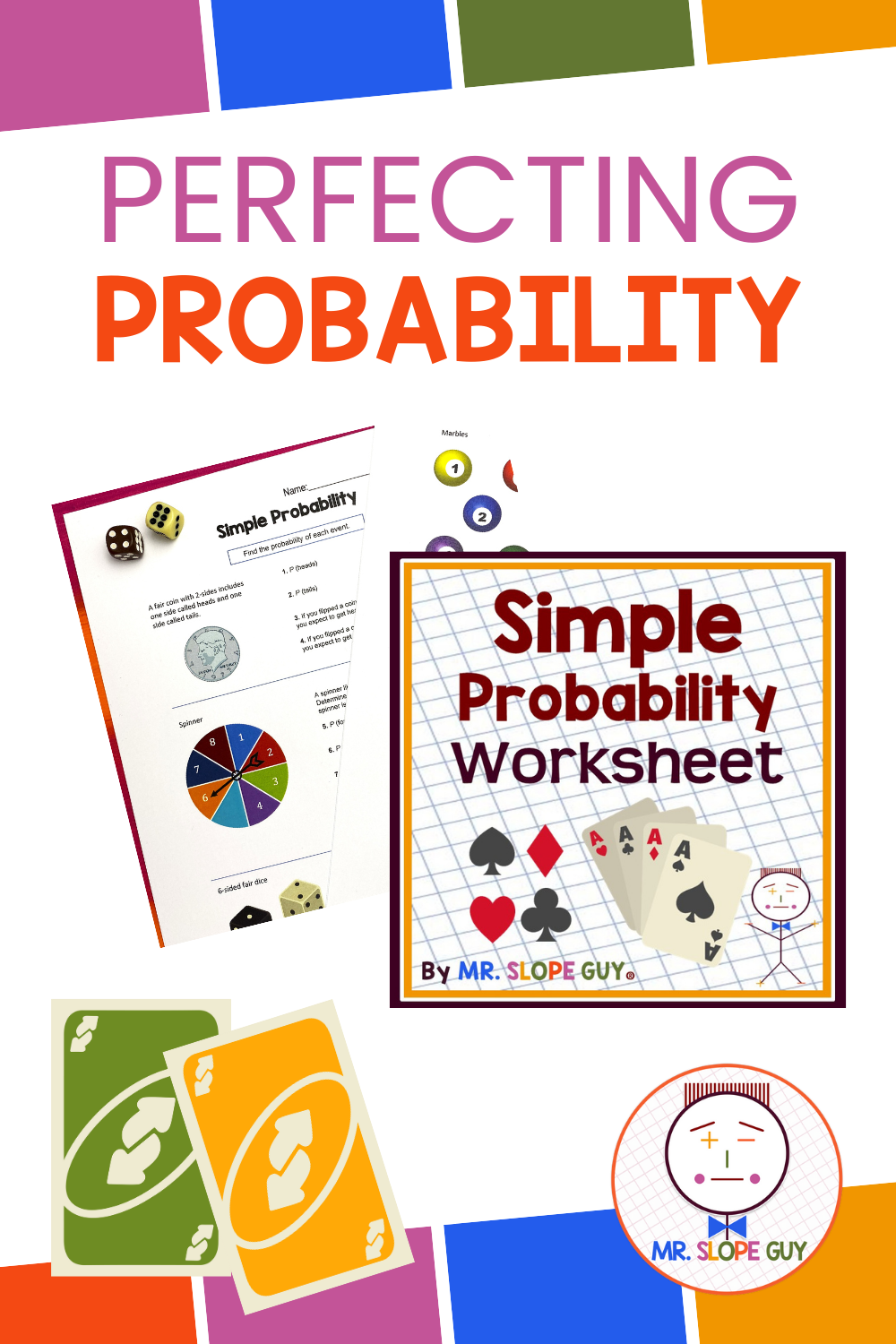
If you’re looking for an easy, no-prep way to help students build a strong probability foundation for about $3, check out my Simple Probability Printable Worksheet Activity for Middle School Statistics.
Click link to preview and download 👉 Simple Probability Printable Worksheet Activity
This worksheet is designed to:
Target foundational probability skills
Use clear visuals and structured questions
Work perfectly for middle school math, small groups, or homeschool settings
Provide focused practice without overwhelming students
Like most Mr. Slope Guy resources, it’s built with scaffolding in mind by starting simple and helping students grow their confidence one outcome at a time.
Final Thoughts
Start concrete. Build slowly. Keep it fun. And give students the right tools to succeed.
Because when probability finally clicks, students realize something powerful:
Math can actually explain the randomness of the world. 🎯