Flip It, Roll It, Multiply It: Independent Probability Made Simple
If probability had a theme song in middle school, it would probably be “Why did my answer change?” 🎲
One minute students feel confident, the next minute they’re multiplying fractions and wondering how flipping a coin twice suddenly became harder than expected.
Welcome to teaching probability of independent events. It’s one of those topics that seems simple on the surface but quickly reveals student misconceptions hiding just beneath the surface.
Let’s break down where students struggle, why it matters, and how to start teaching independent events in a way that actually sticks.
What Are Independent Events ?
Before students ever see the words independent events, they need a story.
Independent events are situations where one event does NOT affect the outcome of another.
Flipping a coin twice
Rolling a die, then rolling it again
Spinning a spinner, resetting it, and spinning again
The key phrase students need to hear repeatedly is:
“Nothing changed between events.”
Middle school brains are still developing logical sequencing and probabilistic reasoning, so this distinction is huge.
Why Students Struggle with Independent Events
1. They Assume Outcomes “Remember” the Past
Students often believe that if a coin landed on heads three times, tails is due. This is classic middle school thinking and totally developmentally normal.
They’re thinking emotionally, not mathematically.
2. Fractions Get in the Way
Even if students understand the situation, multiplying fractions like

can derail the whole lesson.
If fraction fluency is shaky, probability becomes overwhelming fast.
3. They Mix Up Independent and Dependent Events
Students hear independent and think it just means “two things happening.” Without clear contrasts, they’ll treat every probability problem the same way.
4. They Guess Instead of Calculate
Probability feels like guessing to many students. If lessons don’t emphasize models, visuals, and structure, students rely on their intuition which may be wrong.
Where to Start Teaching Independent Probability
Start With Concrete Examples
Begin with experiences students already understand:
Coins
Dice
Spinners
Cards with replacement
Ask questions like:
“Did anything change between the first and second event?”
“Was anything taken away?”
“Was anything added?”
These questions help students classify the situation before calculating.
Teach the Multiply Rule
Students don’t need big vocabulary at first. They need a repeatable process:
Write the probability of the first event
Write the probability of the second event
Multiply
Example:
Probability of heads = 1/2
Probability of heads again = 1/2
Probability of both = 1/2 × 1/2 = 1/4
Keep the structure the same every time so students can build confidence.
Use Visuals Before Abstract Numbers
Tree diagrams, tables, and organized lists are lifesavers here.
Middle school students benefit enormously from:
Seeing outcomes
Labeling probabilities
Connecting visuals to equations
Once students see why multiplication works, the math becomes meaningful instead of magical.
Common Teacher Pitfall (We’ve All Been There)
Jumping too quickly to word problems.
Word problems are important, but only after students can:
Identify independent events
Write probabilities
Multiply fractions confidently
Think of independent probability as a ladder:
Situations → Models → Numbers → Words
Skip a rung, and students fall.
Why Independent Probability Is a Big Deal
Independent events are foundational for:
Compound probability
Tree diagrams
Statistics
Algebraic reasoning
Real-world decision making
This topic isn’t just about coins and dice. It’s about teaching students how chance really works.
How Targeted Practice Makes the Difference
This is where carefully designed worksheets shine.
Students need:
Repetition with variety
Clear structure
Gradual increase in difficulty
Opportunities to check their thinking
Random practice won’t cut it. Independent probability needs intentional scaffolding.
Ready-to-Use Classroom Solution
If you’re looking for a no-prep, student-friendly way to help your middle schoolers master independent events, for about $3, check out this resource:
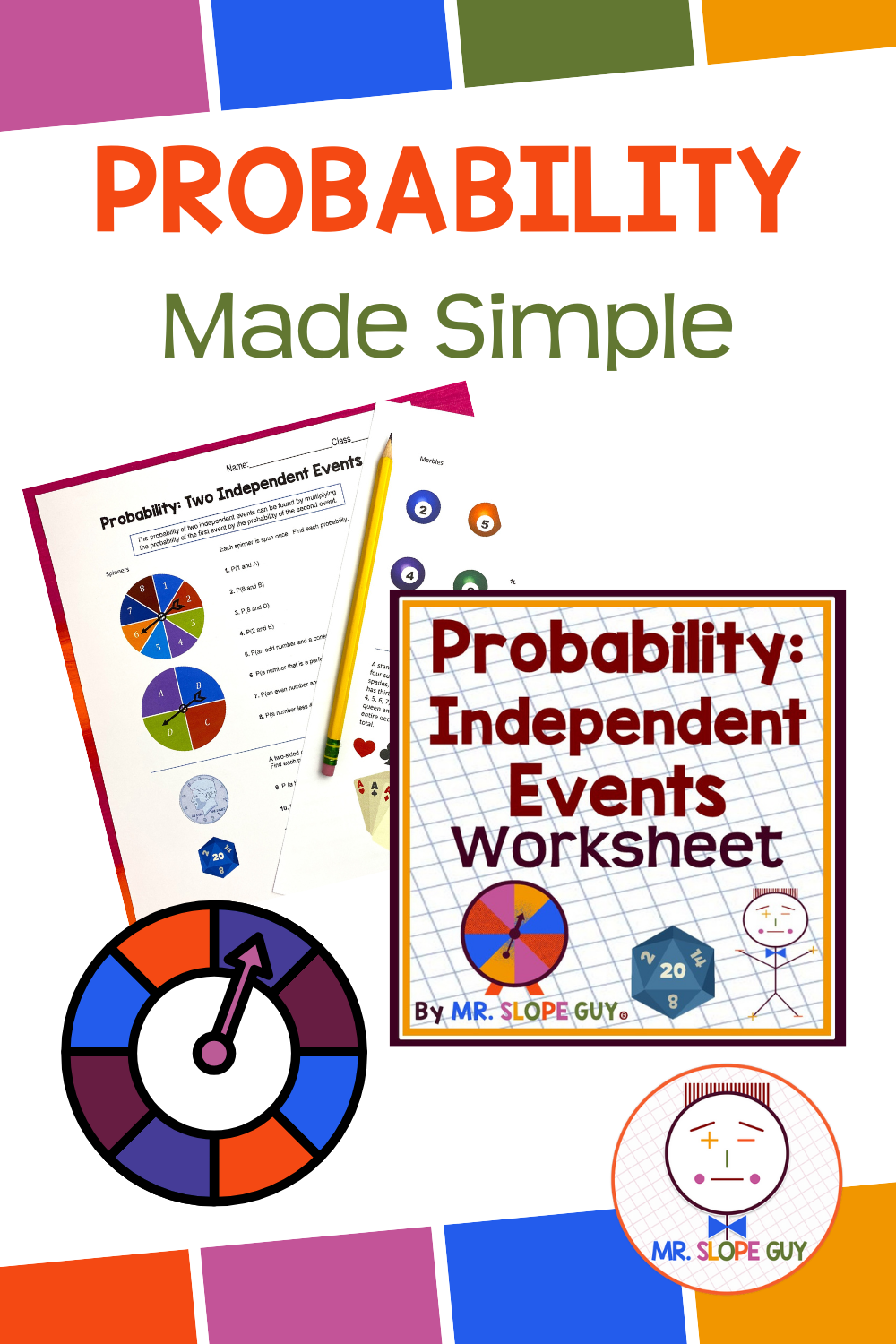
Click link to preview and download: “👉 Probability – Independent Events Printable Worksheet Activity (Middle School Math)”.
Why Teachers Love It:
Focuses specifically on independent events
Helps students identify situations before calculating
Reinforces multiplying probabilities step-by-step
Perfect for classwork, homework, intervention, or review
Clean layout, easy to follow, and easy to grade
Whether you’re introducing probability for the first time or reinforcing key concepts before assessments, this worksheet helps students move from guessing to mathematical confidence.
Because when it comes to probability, luck shouldn’t be part of the learning process 🎯