Teaching Quadratic Graphs Made Easy: Vertex Form, Standard Form and Beyond
If you’ve ever introduced quadratics to your students, you’ve probably witnessed the famous Parabola Panic Face.
It’s the wide-eyed moment where students go:
“Wait… it curves?”
“So it’s NOT a V?”
“Why does it flip sometimes?”
But fear not! With the right visuals, scaffolded practice, and a few math sprinkled jokes, graphing quadratic equations transforms from “scary roller coaster” to “smooth parabola glide.”
Today we’re diving into the wonderfully bendy world of quadratic graphs and why they matter, how to make them stick, and the simple classroom moves that turn confusion into confident curve-sketching.
🌈 Why Quadratics Are a Big Deal
Quadratics show up everywhere and in every algebra course from now until forever.
They help students build core reasoning skills like:
Seeing patterns in non-linear change
Understanding vertex behavior and symmetry
Understanding transformations
Relating equations to graphs
Building fluency with function features
And let’s be honest, parabolas are way more fun to graph than straight lines. It's like slopes… but with a glow-up.
🎢 Common Student Struggles (and How to Fix Them)
1. Confusing the Vertex With the Y-Intercept
Every teacher has heard it:
“So… the vertex is where it crosses the y-axis, right?”
No, my friend. But thank you for your enthusiasm.
Try this fix:
Use mini whiteboards and have students sketch a parabola in any position.
Then point to the vertex and y-intercept and ask, “Who is who?”
Instant clarity.
2. Forgetting That Parabolas Are Symmetric
Students often graph points like they’re decorating a Christmas tree: fun but definitely not balanced.
Help them find the axis of symmetry early, then reflect points.
Symmetry becomes their new best friend.
3. Mixing Up Standard Form and Vertex Form
Standard Form:
Vertex Form:
Kids see these as two different planets.
Try introducing them like characters in a story:
Standard Form: The “mystery” you need to work to uncover the vertex.
Vertex Form: Just reads you the vertex right there.
4. Missing the Role of ‘a’
Whether the parabola opens up, down, wide, skinny—students forget who controls the drama.
Have them test a few values of a and sketch quick mini-parabolas.
Turn it into a graphic organizer: “What happens when a is positive? Negative? Big? Small?”
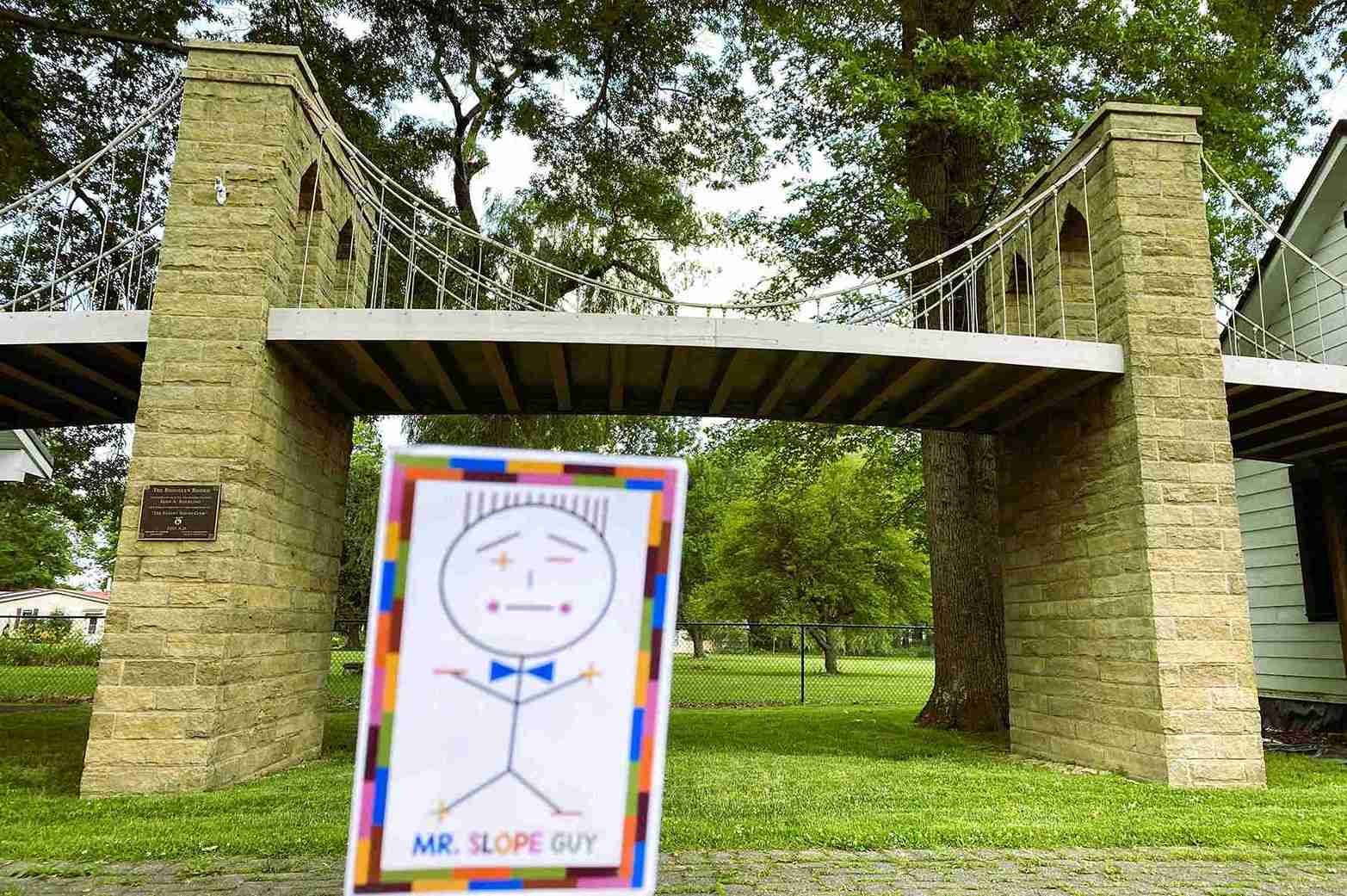
Mr. Slope Guy enjoying a math moment in front of the Brooklyn Bridge replica in Saxonburg, PA He is proving once again that whether it’s engineering or algebra class, curves and structures tell amazing stories.
🌳 Fun Classroom Activities to Bring Quadratics Alive
🎯 1. Parabola Target Practice
Give each group a large graph on butcher paper.
Call out equations and have them run up and sketch the parabola.
It’s chaotic. It’s loud. It’s perfect.
🎮 2. Parabola Transformations Game
Students start with a “parent parabola” and apply transformations you call out.
“Shift right 3.”
“Reflect over the x-axis.”
“Make it narrower!”
It’s function aerobics.
📸 3. Parabola Scavenger Hunt
Have students search the school for real-world parabolas: bridges, basketball arcs, art installations, water fountains.
They’ll start seeing parabolas everywhere.
📺 4. Combine Worksheet Practice With Quick Video Tutorials
Many students need visuals when switching between forms.
Paired video + printable practice helps them fill the learning gaps quickly.
🧠 Why Graphing Quadratics Builds Strong Algebra Foundations
Quadratic graphing leads directly to skills your students will need later:
Solving quadratic equations
Connecting factors, roots, and graph features
Understanding maximums/minimums
Making sense of projectile motion
Becoming generally unstoppable humans who can graph anything
Plus… watching students finally nail their first perfect parabola?
📘 Want Ready-to-Go Quadratic Graphing Worksheets?
For about $5, I made three great quadratics worksheets that you can use in your class too.
Click link to preview and download: “Graphing Quadratics in Standard and Vertex Form Worksheets”.
This bundle includes:
Scaffolded practice
Mixed form problems
Clear coordinate plane layouts
Real-world inspired examples
Perfect for classwork, homework, review, or reteach
Activities pair beautifully with free video lessons on my YouTube channel.
Help your students master parabolas one curve at a time!