Understanding the Total Cost of Loans: A Financial Literacy Lesson for Middle and High School Students
Many students are surprised to learn that when you borrow money, you usually repay much more than the amount you originally borrowed. Whether you're buying a car, paying for college, or purchasing a home someday, understanding the true cost of a loan is one of the most important financial literacy skills you can learn.
That's why I encourage middle school and high school students to use a loan calculator to explore how interest rates and loan terms affect the total amount repaid over time.
What Is a Loan?
A loan is money that you borrow from a bank, credit union, or other lender. The lender expects you to repay the money plus interest.
The three most important parts of a loan are:
Loan Amount – The amount of money borrowed.
Annual Interest Rate – The percentage charged by the lender each year.
Loan Term – The length of time you have to repay the loan.
Together, these factors determine your monthly payment and the total cost of borrowing.
Why Interest Matters
Many students focus only on the monthly payment when looking at a loan. While monthly payments are important, they don't tell the whole story.
A lower monthly payment often means you are paying the loan back over a longer period of time. The longer you borrow money, the more interest you pay.
This is why understanding Total Payment and Total Interest is so important.
A Real-Life Example
When I bought my first house for $54,000 at 7.5% Annual Interest Rate for 30 years, I was shocked that my Total Payment would be $135,927.
I did not know that I would have to sign to repay a loan with such a huge number.
At the time, I was focused on whether I could afford the monthly payment. I wasn't paying enough attention to the total amount I would eventually repay over three decades.
That experience taught me an important financial lesson: the cost of borrowing money can be much higher than the original purchase price.
In this example:
Loan Amount: $54,000
Interest Rate: 7.5%
Loan Term: 30 Years
Total Payment: Approximately $135,927
That means the lender received over twice the original amount borrowed by the end of the loan term.
How a Loan Calculator Helps Students Learn
A loan calculator allows students to experiment with different loan situations and immediately see the results.
By entering:
Loan Amount
Annual Interest Rate
Loan Term
students can calculate:
Monthly Payment
Total Payment
Total Interest
This helps students answer important questions such as:
How much more will I pay than I borrowed?
How does a higher interest rate affect the total cost?
What happens if I choose a 15-year loan instead of a 30-year loan?
How much money can be saved by paying off a loan faster?
These are real-world financial decisions that adults make every day.
Try Some Loan Scenarios
Students can use a loan calculator to compare different situations:
Buying a Used Car
Loan Amount: $15,000
Interest Rate: 6%
Loan Term: 5 Years
Paying for College
Loan Amount: $25,000
Interest Rate: 5%
Loan Term: 10 Years
Purchasing a Home
Loan Amount: $250,000
Interest Rate: 7%
Loan Term: 30 Years
After calculating each scenario, students can compare the total interest paid and determine which loans are most expensive over time.
Building Financial Literacy for the Future
Financial literacy isn't just about balancing a budget or saving money. It's also about understanding how borrowing works and making informed decisions before signing a loan agreement.
Many adults discover too late that a loan's total cost is much higher than expected. Students who learn these concepts now will be better prepared to make smart financial choices later in life.
A few minutes spent exploring loan calculations today can help students avoid costly mistakes in the future.
Free Loan Calculator for Students
Want to see how loans really work?
Use my free loan calculatorto explore different loan amounts, interest rates, and loan terms. You'll instantly see the monthly payment, total payment, and total interest for any loan scenario.
Free Loan Calculator: https://www.mrslopeguy.com/loan-calculator
Classroom Activity for Grades 8–9
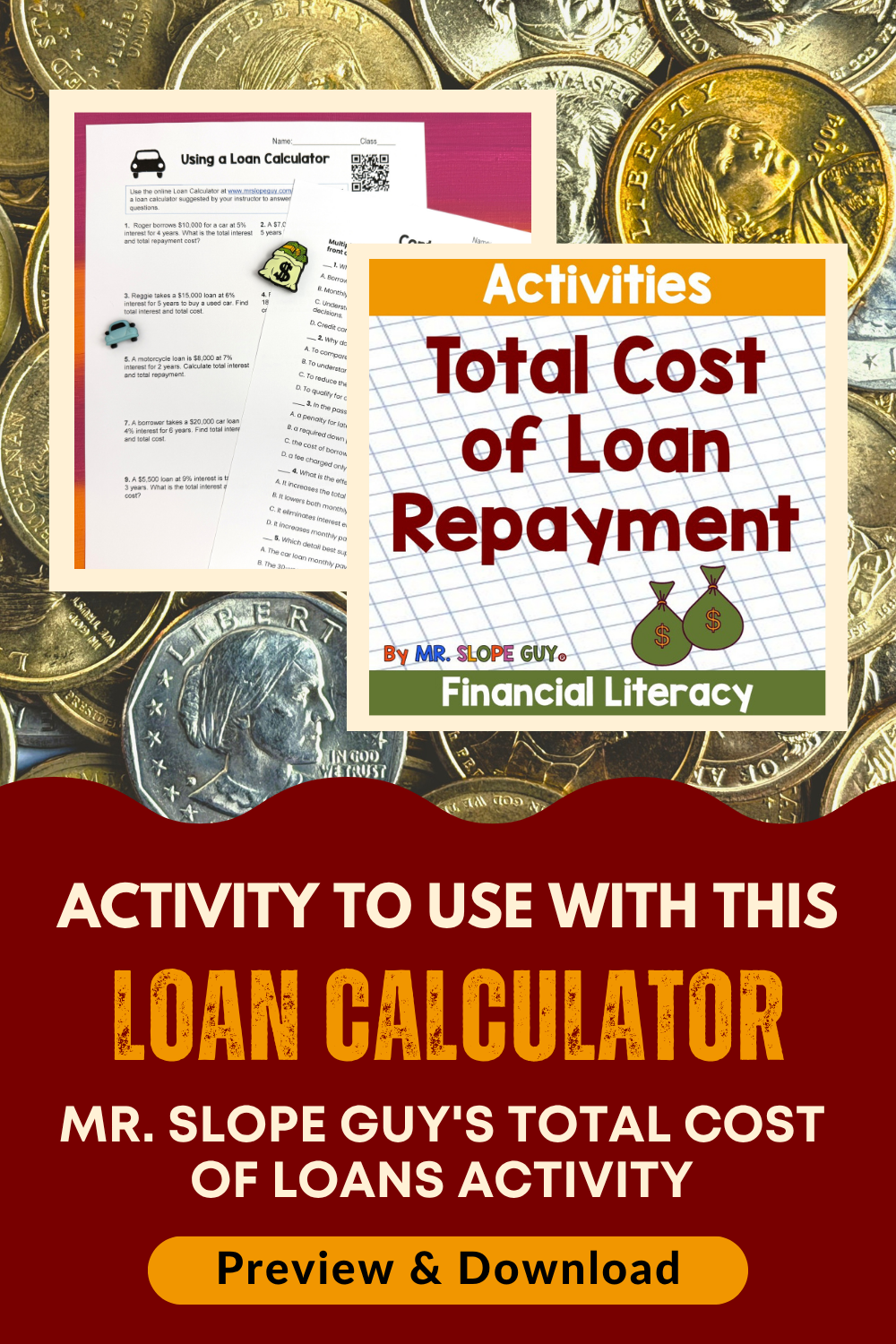
If you're a teacher looking for a ready-to-use financial literacy lesson for about $3, check out the Total Cost Loan Repayment Financial Literacy Activities Grades 8–9 Life Skills resource. Students use loan scenarios to calculate and analyze the true cost of borrowing money while building valuable real-world math and financial literacy skills.
Click here to preview and download: Total Cost Loan Repayment Financial Literacy Activities Grades 8–9 Life Skills
Teaching students to look beyond the monthly payment and examine the total cost of a loan is one of the most practical financial lessons we can provide. The earlier they learn it, the better prepared they'll be for their financial future.