Solving Multi-Step Inequalities: Common Mistakes and Smart Strategies
If there is one algebra topic that can turn confident middle schoolers into nervous mathematicians overnight, it’s multi-step inequalities. I’ve seen it year after year. Students start strong solving one-step equations, feel pretty good about two-step equations… and then inequalities enter the room like an unexpected substitute teacher. Suddenly hands go up, brows furrow, and someone inevitably asks, “Wait… do I flip the sign or not?”
Before we even talk about solving multi-step inequalities, we need to talk about where students are starting from. That starting point matters more than we sometimes realize.
The Alligator Memory That Never Dies 🐊
When I was in elementary school, my teacher taught us that the alligator mouth always opens toward the larger number. And let’s be honest, that image sticks. I’ve taught students who can’t remember the slope formula, but they absolutely remember the hungry alligator.
That visual is not a bad thing. In fact, it’s a great foundation. But here’s where students get stuck later:
They understand which number is larger… until variables and multiple steps show up.
Suddenly the inequality symbol isn’t just comparing two numbers. It’s guarding an algebraic expression. And now the alligator looks confused too.
Why Multi-Step Inequalities Feel So Hard
Multi-step inequalities combine several skills students are still mastering:
Combining like terms
Using the distributive property
Solving two-step equations
Understanding inverse operations
Interpreting inequality symbols
Knowing when (and why!) to flip the inequality sign
That’s a lot for one problem. It’s no wonder students feel overwhelmed.
The biggest issue I see? Students rush straight to the inequality sign instead of simplifying first.
Start with What Students Know
The best place to start with multi-step inequalities is to treat them like equations.
I tell students:
“Solve this exactly like an equation… until the very last step.”
This lowers anxiety immediately. They already know how to:
Distribute
Combine like terms
Move variables to one side
Isolate the variable
Once everything is simplified, then we pause and talk about the inequality.
The Moment That Changes Everything: Flipping the Sign
This is the moment students fear and the moment teachers must slow down.
Students don’t struggle because they forget to flip the sign.
They struggle because they don’t understand why.
When multiplying or dividing by a negative number, the inequality flips because the order of values reverses on the number line. This is where visuals, number lines, and repeated practice matter.
If we don’t follow this rules, our graph will have solutions in the shaded area that do not work in the original equation.
This is also where worksheets with scaffolded problems make a huge difference. Students need to see:
Problems where the sign does not flip
Problems where the sign does flip
Clear patterns they can recognize
Random practice doesn’t build confidence. Structured practice does.
Common Student Mistakes (and Why They’re Normal)
Here are mistakes I expect to see and don’t panic over:
Flipping the inequality sign every time “just in case”
Forgetting to flip it when dividing by a negative
Solving perfectly… but writing the final answer backwards
Mixing up “greater than” and “less than” when graphing solutions
These mistakes tell us something important:
Students are thinking. They just need more guided repetition.
Why Practice Matters More Than Speed
Multi-step inequalities are not about being fast. They are about being methodical.
Students need:
Repetition
Clear steps
Immediate feedback
Confidence that they’re doing it right
This is especially true in middle school, where abstract thinking is still developing. Inequalities are one of the first places where students see math behave slightly differently than what they’re used to—and that’s uncomfortable.
The cure isn’t shortcuts.
It’s well-designed practice.

Make it stand out
Mr. Slope Guy poses with a hungry alligator statue deep in the Florida Everglades. It’s proof that the alligator mouth really does open toward the larger number!
Ready-to-Use Practice That Actually Works
If you’re looking for an engaging, no-prep way to help students finally feel confident with multi-step inequalities, I’ve got you covered.
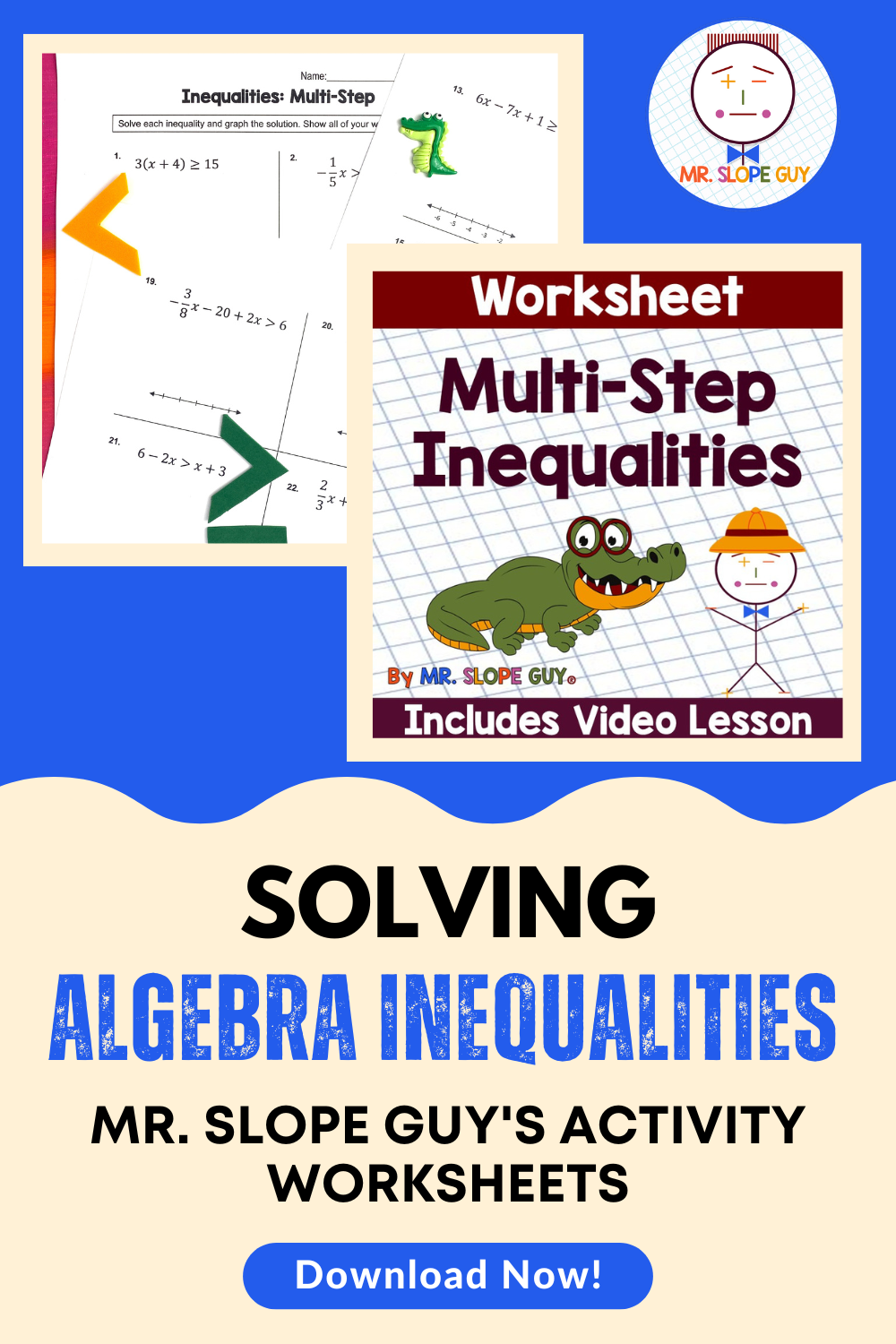
For less than $3, you can preview and download: “👉 Solving Multi-Step Inequalities Printable Worksheet Activity for Algebra”.
This resource is designed specifically for middle school and Algebra students who need structured, meaningful practice.
Why Teachers Love It:
Step-by-step problems that build confidence
Focus on simplifying before solving
Clear examples of when to flip the inequality sign
Printable PDF that is perfect for classwork, homework, or intervention
Easy to grade and easy for students to follow
🎯 Download the worksheet here:
Multi-step inequalities don’t have to feel like wrestling an alligator. With the right foundation, clear steps, and intentional practice, your students can learn to solve them with confidence. 🐊📐.